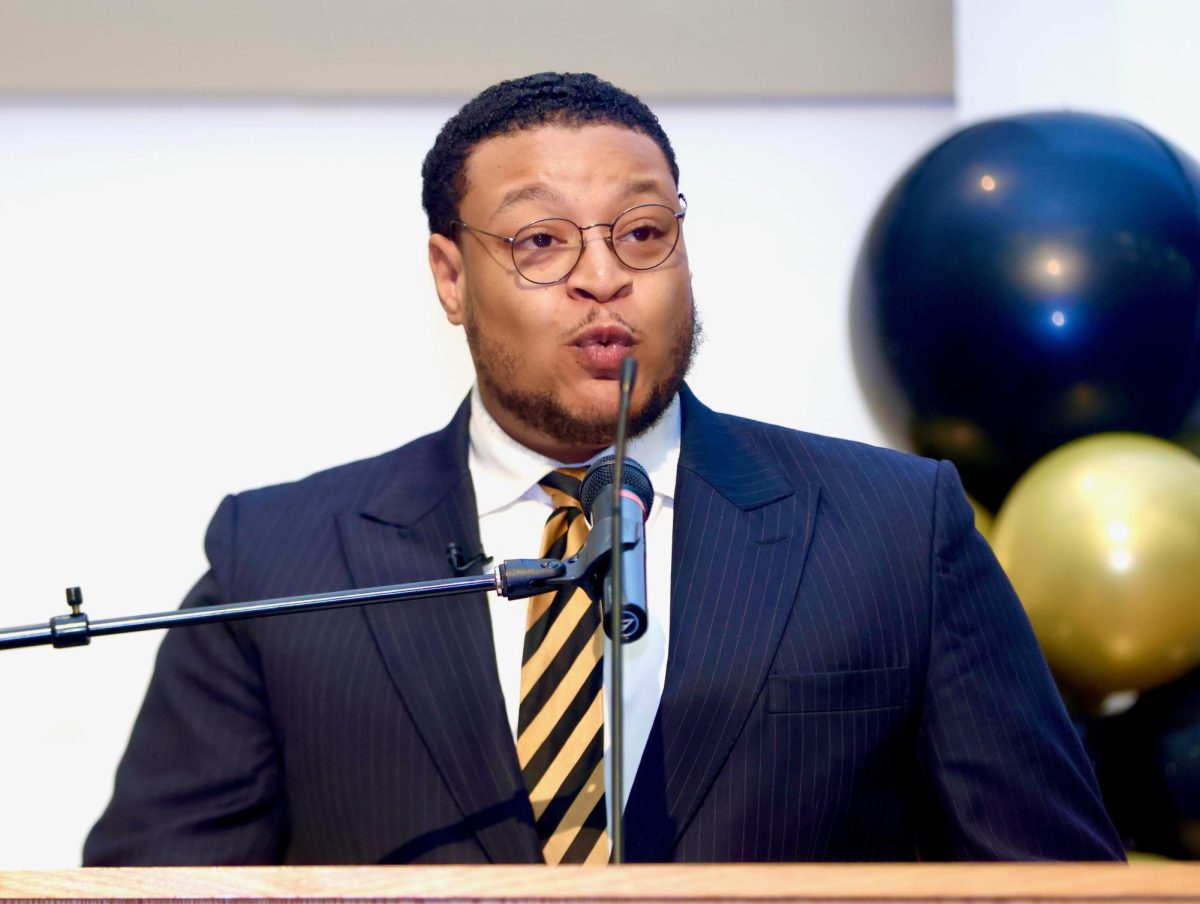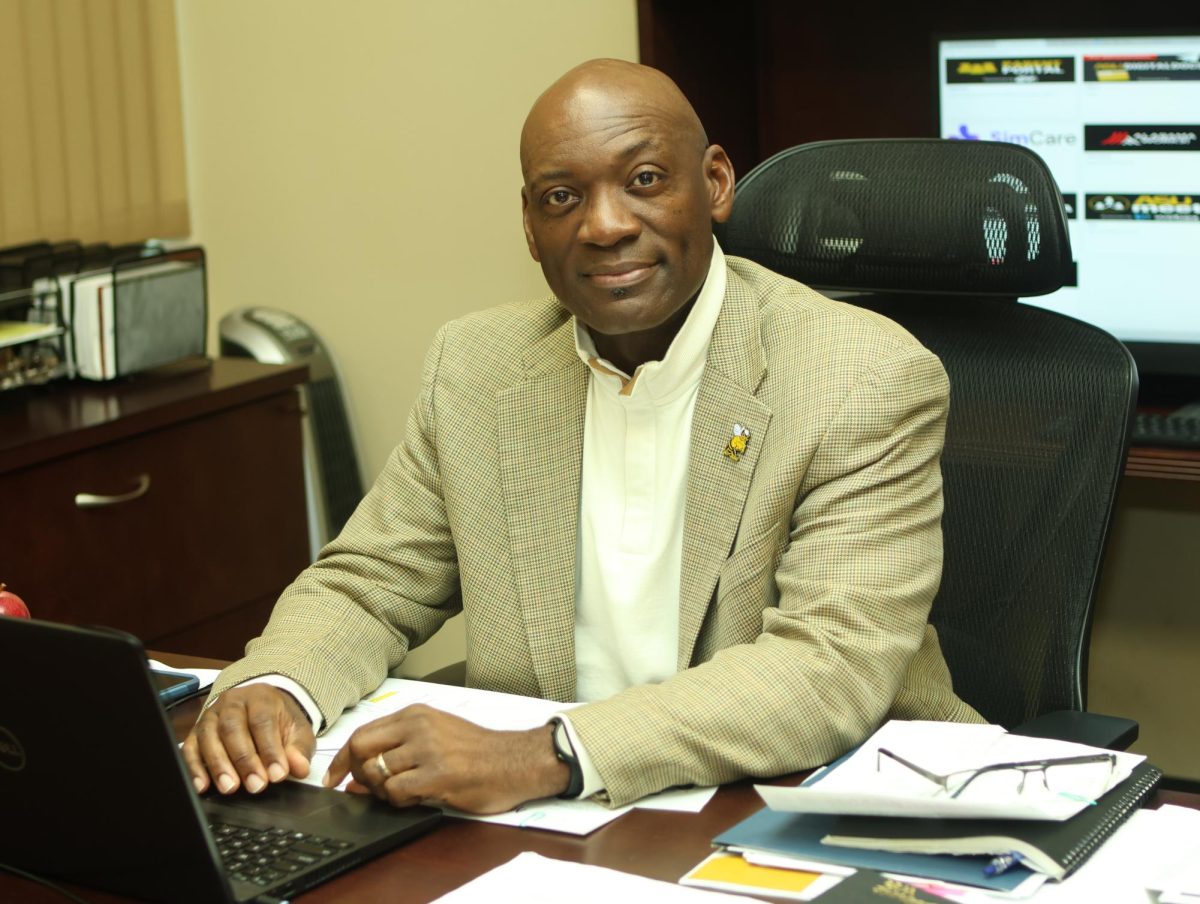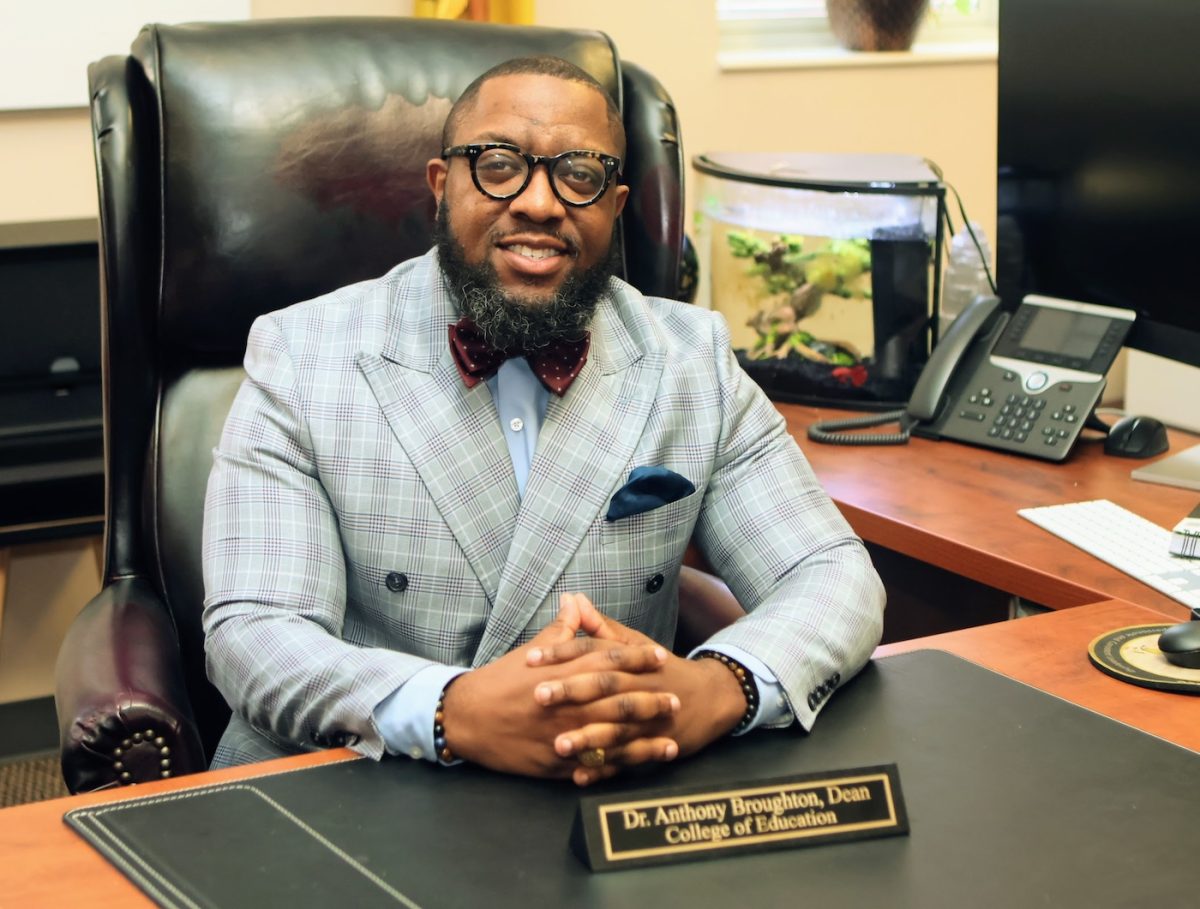
The dean of Alabama State University’s College of Education, Anthony Broughton, Ph.D., shared that improving licensure examination pass rates, strengthening faculty capacity and safeguarding the college’s accreditation are immediate priorities as he begins his tenure.
During an interview, in his office, on Feb. 17th, he outlined a reform strategy that includes expanded examination preparation, instructional innovation, and a shift in the college’s mindset.
Before being appointed dean on Jan. 1, Broughton served four years as associate dean and associate professor in the College of Education. His experience within the college, “gives him a clear understanding of its operational gaps and institutional strengths.”
He earned a doctorate in early childhood education and is also an author whose work focuses on leadership, empowerment and educational transformation.
Based on his experience within the department, Broughton mentioned that the expansion of state-required certification examinations significantly altered the landscape of teacher preparation.
“There was an entity that generated teacher preparation examinations,” he said. “After they created some exams, they started creating more, and those created the barriers.”
Education majors must now pass Praxis content exams, Foundations of Reading, the Teacher Performance Assessment and a numeracy requirement aligned with the Alabama Numeracy Act.
“This was not always the case,” he said. “It used to be more or less one test. Now what we are experiencing is a series of test failures.”
Broughton added that approximately 30 students have successfully passed required licensure exams in the current cycle, a number he acknowledged reflects a serious challenge within the teacher pipeline.
When asked how low pass rates affect accreditation, Broughton noted that the program remains accredited but completion and licensure data are closely monitored.
“Yes, we are accredited,” he said. “They look at our completion rates.”
He included that improving those outcomes requires embedding preparation earlier in the curriculum rather than waiting until students approach graduation.
“At some point, we cannot wait until senior year to prepare for these tests,” he said. “Preparation has to be embedded.”
To support that shift, he expressed that the college is increasing structured lab engagement and directing students to external digital study resources, including study.com.
“I keep pushing students to the labs and to study.com,” he said. “The more they see it, the more confident they are.”
Broughton asserted that repetition and exposure reduces anxiety and improves performance.
“You go in focused,” he said. “They ask you a question and you respond.”
He attributed repeated failures in part to confirmation bias and imposter syndrome.
“If you fail the test, you begin to doubt yourself,” he said. “We have the content. We have the concepts. But when we sit for the test, we doubt ourselves.”
He noted that narratives surrounding licensure exams often heighten fear.
“You hear that it is hard. You hear that it is scary,” he said. “You play those narratives in your head, not knowing that you have what it takes.”
Beyond student preparation, Broughton expressed that instructional delivery must evolve to meet students where they are.
“I believe learning should be an amalgamation of different learning styles and modalities,” he said. “Movement. Interaction. Engagement.”
He said adapting teaching methods does not mean lowering standards.
“This generation is different,” he said. “They are more distracted. They have social media. They have phones. So we have to teach differently.”
Broughton said he has not faced direct opposition to his plans, but he has noticed a recurring narrative within academic spaces from faculty who attribute systemic challenges to students.
“They say those students do this. Those students do not do that,” he said.
Broughton said the tendency to place responsibility solely on students must change if outcomes are to improve.
His vision, he explained, includes expanding faculty ranks to strengthen mentorship and academic support.
“You cannot drive vision alone,” he said. “My goal is to have more faculty members join and work.”
He also added that additional hires would allow for targeted examination intervention, stronger lab instruction and better alignment between coursework and licensure expectations.
Historically known as “Teacher’s College,” the College of Education once produced some of the largest cohorts of educators in the state. Broughton explained that restoring that reputation requires structural reform, consistent accountability and belief.
“We have to shift the marginal mindset,” he said. “Seeing beyond the present moment. Seeing your potential.”
As he begins his first semester as dean, Broughton wants his focus to remain on measurable outcomes.
“They look at our completion rates,” he said. “They look at our pass rates.”
Improving those numbers, he added, restores institutional confidence.
“We have what it takes,” Broughton said. “Now we have to believe it.”